




Measurement science and research

Anyone can claim validation. We can name it.

Every product in this category says it has been validated against laboratory standards. Very few will tell you which laboratory, which study, or who put their name to the result. Ours is on the public record.

Evidence

On the record.

  • 01

    Independently validated

    The University of Queensland

    Kinelitics is validated against laboratory motion capture at UQ — ranked 1st in Australia and 2nd in the world for sports-related subjects, six years running — not an internal benchmark we marked ourselves.

    QS World University Rankings by Subject 2026

  • 02

    Competitive grant, publicly funded

    Queensland Government

    Our work on AI-based Paralympic classification is carried by competitive Queensland Government funding, with our partners from the University of Queensland.

    Industry Research Projects IRP098-2023 · Department of the Environment, Tourism, Science and Innovation

  • 03

    Deployed at state scale

    Queensland Academy of Sport

    A prominent force in the iconic Australian State Institute and Sport Academy System uses this technology to screen athletes for the Brisbane 2032 pathway.

    YouFor2032 — delivered with QAS

  • 04

    Supported at governing-body level

    Paralympics Australia and the International Paralympic Committee

    Both governing bodies put their name to the classification research behind this technology. Classification decides who competes against whom, so the measurement underneath it has to be defensible.

    Supporting Industry Research Projects IRP098-2023

  • 05

    Built by practitioners

    Australian Institute of Sport

    Kinelitics was founded and guided by sports scientists whose career at the AIS and in High Performance Sport was spent refining the measurements this technology now delivers without AIS-calibre biomechanics labs and equipment — we know what institute-grade means because we spent years being held to it.

    Founded out of high performance sport

…to achieve definitive, evidence-based Para sport classification for any athlete with a mobile phone, anywhere in the world. In a very literal sense, classification of this quality and accessibility… a game changer.

Catherine Clark, Chief Executive Officer

Paralympics Australia

The engine

Why a phone can stand in for a laboratory.

A camera is only ever as good as the model reading it. Ours is the subject of its own research program — and the work that improves the model is the same work that produces our data.

  1. 01

    Teaching flat video to see in three dimensions

    A video is flat. Movement isn't. Getting from one to the other is the central problem in this field, and it is what our Australian Research Council Linkage project with the University of Queensland and the University of Adelaide is built to solve. Every gain there lands in the app people are already using.

  2. 02

    Several people at once, measured on the device

    Assessing a whole group accurately, with nothing leaving the phone, is the difference between a laboratory you travel to and one that travels with you. That is the other half of the same research program.

  3. 03

    The advantage that compounds

    Classification research produces something rare: carefully labelled movement data, gathered to a standard a laboratory would accept, across bodies that move in a genuinely wide range of ways. Paired with the model development within the ARC linkage research, it means the engine keeps improving in a way that more money alone cannot buy.

ARC Linkage Project LP250201038 — Next-Gen Markerless 3D Motion Capture from Sparse Camera Views · University of Adelaide · University of Queensland · Multiple PhD and Post Docs supported

Research programs

Where the science is applied.

Program

YouFor2032

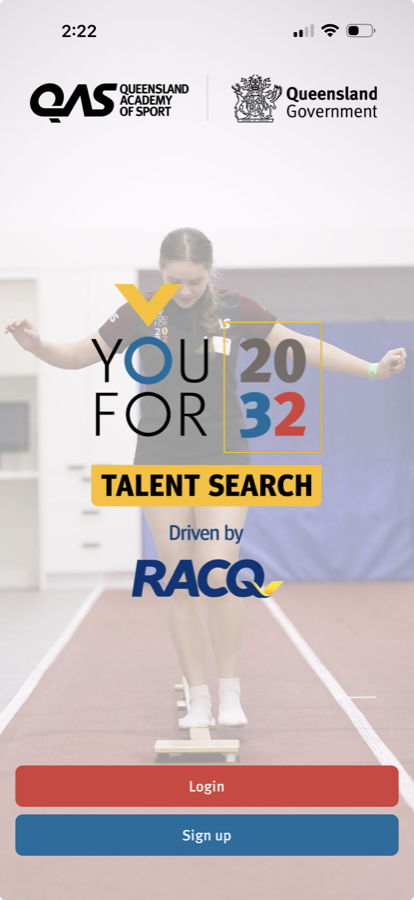
Queensland's talent identification pathway for the Brisbane 2032 Olympic and Paralympic Games, delivered with the Queensland Academy of Sport. Kinelitics provides the remote screening technology that lets young Queenslanders be assessed from anywhere in the state — without travelling to a sports institute.

Since deployment, the program has enabled remote assessment at a scale that would be logistically impossible with traditional laboratory-based testing. Athletes aged 13 and over can complete a validated movement assessment from home, in school, or in their local community.

Delivered in partnership with the Queensland Academy of Sport.

The YouFor2032 Talent Search app, badged Queensland Academy of Sport and Queensland Government, with the Talent Search lockup over footage of an athlete performing a balance test.

Research

Classification & clinical

We lead a Queensland Government-funded research program on AI-based movement classification with the University of Queensland alongside ARC-linkage with the Universities of Queensland and Adelaide — research that refines our approach to movement-based assessment of loss-of-function through illness, injury and ageing.

Industry Research Projects IRP098-2023, delivered with the University of Queensland.

Applied Research

Movement Health and Longevity

Falls are the leading cause of injury-related hospitalisation in Australians over 65. The same computer vision that assesses elite athletes reads the early markers — balance degradation, gait asymmetry, reduced lower-limb power — before a fall occurs. Kinelitics is developing that as camera-based screening for aged care and community health: a standard tablet, no wearables, no clinician travel.

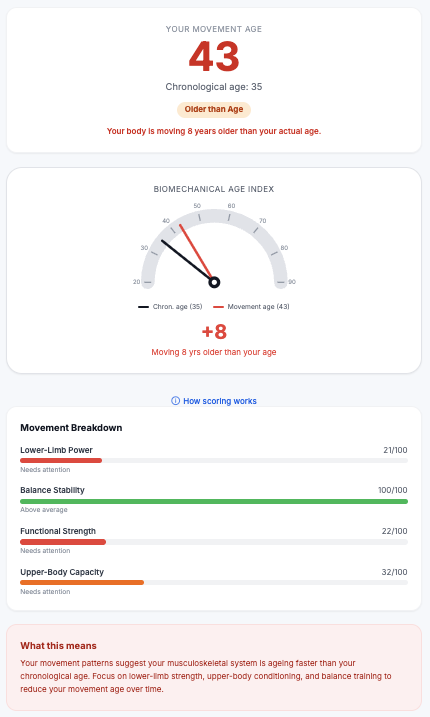
The Kinelitics Biomechanical Age Index shown here is one of those markers, still in validation with our university partners, as are the other measures behind it. We will tell you what an index can be trusted to say today rather than claim more for it than the evidence carries.

Australian Institute of Health and Welfare, Injury in Australia: Falls, 2023.

In development. Expressions of interest from aged care operators and health insurers welcome — info@fome.ai

A Kinelitics Biomechanical Age Index report. Movement age 43 against a chronological age of 35, eight years older, shown on a gauge with two needles. Lower-limb power 21 out of 100, functional strength 22, upper-body capacity 32 all needing attention; balance stability 100 out of 100, above average.

Measurement science

Most standardised tests were standardised for convenience.

Many prominent field tests that gate movement classification or functional fitness decisions, morbidity and mortality risks, rehabilitation stages, health and fitness assessment and aged care intervention have survived on how easy they are to administer, not on how well they measure. At best they list a time or permit a repetition. Often they record no more than a subjective opinion without measurable underpinnings.

Kinelitics treats every test as an instrument that has to be validated. Working through our university partners and their laboratories, we ground-truth each one against gold-standard reference — motion capture, force plates, instrumented protocols — and then either rebuild it to measure what it claims to measure, or replace it with something that measures it better.

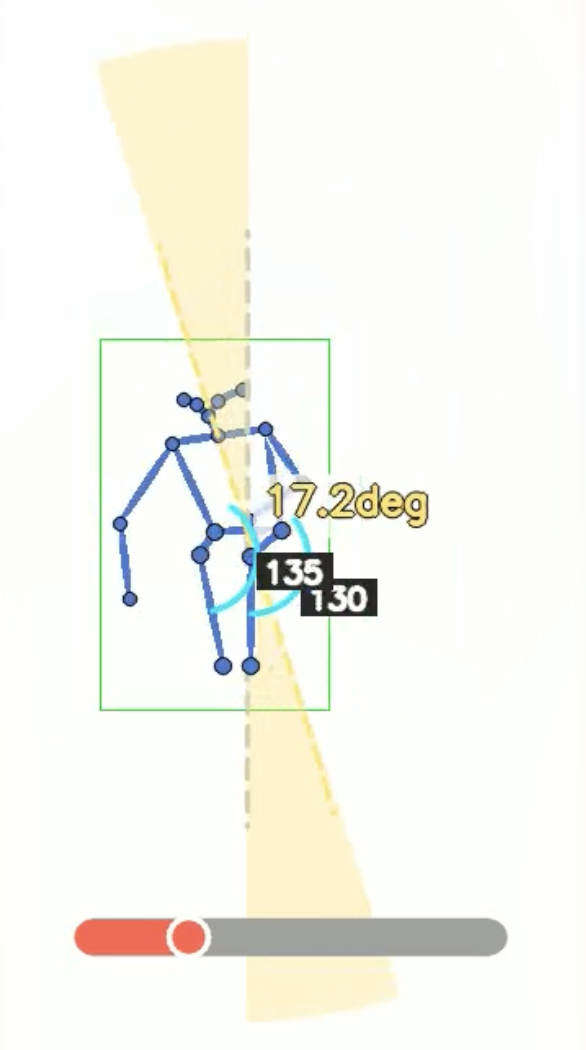
A sitting-rising test captured on a phone, with the pose overlay drawn on the subject: joint angles of 135 and 130 degrees marked at the hip and knee, and 17.2 degrees of trunk lean measured against the vertical.
The capture
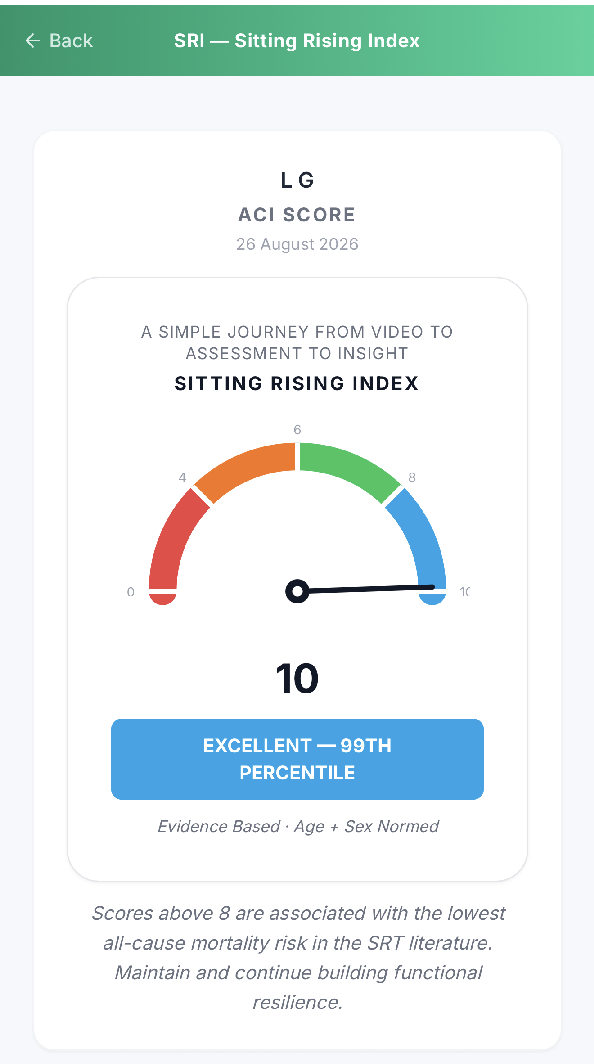
A Kinelitics Sitting Rising Index result: a gauge reading 10 out of 10, rated excellent at the 99th percentile, age and sex normed, noting that scores above 8 are associated with the lowest all-cause mortality risk in the sitting-rising test literature.
The result

Sitting-Rising Test

Araújo protocol · 0–10 composite

Scored by an observer, out of ten, by subtracting points for hands, knees and loss of balance. Two raters can watch the same rise and disagree. From video we recover the score — and with it the joint kinematics, support strategy and time course that a single integer throws away.

Scored by
Observer judgement
Recovered
Kinematics + strategy

Sample output — Sitting Rising Index

The same capture, scored. A simple journey from video, to assessment, to insight.

Why this matters beyond the test

This is the work our Paralympic classification and ARC Linkage programs exist to do. Objective, camera-based measurement doesn't only make existing tests cheaper to administer — it makes it possible to reimagine what classification, return-to-function assessment and healthy ageing screening could look like if the underlying measurement could be trusted in the first place.

Who built it

Built by people who did it the hard way

Peter Logan

Peter Logan, PhD

Founder & Chief Executive

Formerly Australian Institute of Sport

Follow Me AI Pty Ltd

Kinelitics is built by Follow Me AI Pty Ltd, founded by Peter Logan, PhD, whose career in high performance sport has centred on the measurement of elite athlete movement.

The methods that produce that quality of insight have always required a laboratory, expensive equipment, and multiple specialists to interpret the output — which is why almost nobody outside elite sport has ever had access to them.

Kinelitics exists to change that. We assemble sports science, computer vision and machine learning into technology that produces institute-grade movement data from a phone.

The measurement rigour that defined careers in high-performance sport is the standard we hold ourselves to in every validation study and every product decision.

  • Tom Wackwitz

    Tom Wackwitz, PhD

    Sport and Exercise Science Lead

    Tom holds a PhD in sports and exercise science and brings deep expertise in applied movement analysis across elite sport and exercise physiology settings. At Kinelitics he leads the scientific design of our test protocols and movement indexes — ensuring that what the camera measures is what the science requires.

  • Steve Telburn

    Steve Telburn

    Business Development

    Steve has guided start-up ventures across sectors including health and AI technology, and enterprise software. He leads Kinelitics' commercial partnerships, investor relationships, and market development — connecting the technology to the organisations that can deploy it at scale.

  • A/Prof Xin Yu

    A/Prof Xin Yu, PhD

    Computer Vision Advisor

    Australian Institute for Machine Learning · University of Adelaide

    Xin Yu is an Associate Professor at the Australian Institute for Machine Learning, University of Adelaide, and one of Australia's leading researchers in computer vision and deep learning. He advises Kinelitics on the design and development of our pose estimation engine — the model at the centre of everything we build.

Work with us

Work with us

Kinelitics is the movement assessment platform of Queensland's own Follow Me AI Pty Ltd. We work with sports institutes, universities, healthcare organisations, government agencies, and technology partners. If you are building something that depends on accurate, accessible movement data — or if you need a technology partner with the validation credentials to support a serious institutional relationship — we would like to hear from you.

  • Institutional partnerships

    Sports institutes, universities, government, and healthcare operators.

    Follow Me AI Pty Ltdinfo@fome.ai
  • Practitioners & gyms

    Clinics, gyms, and exercise professionals using Kinelitics day to day.

    What Kinelitics does